
Google is not simply refreshing how search results look, it is fundamentally rebuilding how information is retrieved, evaluated, and surfaced.
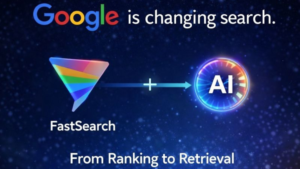
With the rollout of AI Overviews, Google has moved beyond the traditional “rank ten blue links” model and into an AI‑native search architecture. At the core of this transformation is a retrieval layer known as FastSearch, which is quietly redefining what visibility means in modern SEO.
This shift has major implications for brands, publishers, and businesses that rely on organic search as a growth channel.
From Ranking Everything to Retrieving the Right Things
Historically, Google Search worked by performing deep ranking operations across billions of indexed pages. The goal was exhaustiveness: evaluate as much content as possible, then rank it based on hundreds of signals such as backlinks, authority, relevance, and engagement.
AI Overviews change this paradigm.
Instead of ranking everything, Google now focuses on retrieving a smaller, semantically optimized candidate set of documents. This is where FastSearch comes in.
FastSearch acts as a high‑speed retrieval layer that surfaces content most likely to:
- Answer the query clearly
- Be contextually relevant
- Be efficiently processed by large language models like Gemini
Only after this reduced set is identified does Google’s AI synthesize answers in real time.
In other words, if your content is not retrieved, it cannot be summarized — regardless of how well it ranks traditionally.
Why FastSearch Changes the Rules of SEO
This architectural shift creates several important downstream effects.
1. Latency Is Prioritized Over Exhaustiveness
FastSearch is optimized for speed and contextual precision, not comprehensive ranking.
That means:
- Google favors content that can be understood quickly
- Pages that are structurally clean and semantically explicit gain an advantage
- Long, unfocused, or poorly organized content becomes harder to retrieve
The question is no longer “Is this the best page on the internet?” but rather:
“Is this page fast and clear enough for AI to confidently use right now?”
2. Traditional Search Signals Are Being Reweighted
Backlinks, authority scores, and historical rankings still matter — but their role has changed.
In an AI‑generated answer environment:
- Links influence trust, not guaranteed visibility
- Position #1 does not automatically mean inclusion in AI Overviews
- Content relevance and clarity can outweigh raw authority
This is why some lower‑authority sites are now appearing in AI summaries, while well‑established pages are sometimes excluded.
3. Semantic Clarity Is Now a Prerequisite
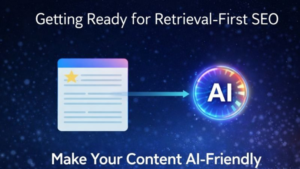
For content to be usable by AI systems, it must be machine‑legible.
That includes:
- Clear topical focus
- Logical structure and headings
- Explicit definitions and explanations
- Reduced ambiguity in language
Content written only for human persuasion — without regard for machine interpretation — is increasingly disadvantaged.
From Ranking‑Based SEO to Retrieval‑Worthiness
The most important shift is conceptual.
Visibility is no longer determined solely by where a page ranks.
Instead, it depends on whether your content is retrieval‑worthy — meaning it can be:
- Quickly identified
- Accurately interpreted
- Reliably summarized by AI systems
If your page cannot pass this retrieval filter, ranking improvements alone will not help.
What “Machine‑First Content Design” Looks Like
As AI‑generated responses become the primary interface for information discovery, content strategy must evolve.
Machine‑first content design prioritizes:
- Clear semantic structure over keyword stuffing
- Topic depth over surface‑level coverage
- Explicit answers over vague marketing language
- Modular sections that AI can extract and summarize
This does not mean writing for machines instead of humans.
It means writing for humans in a way machines can reliably understand.
AI Overviews Are the Surface — FastSearch Is the Infrastructure
AI Overviews are what users see.
FastSearch is what makes them possible.
This infrastructure enables Google’s shift toward:
- Faster answers
- More targeted retrieval
- AI‑native search experiences
For businesses and content creators, the message is clear:
SEO is no longer just about ranking higher — it’s about being selected by AI.
Those who adapt their content strategy to this new retrieval‑driven reality will maintain visibility. Those who don’t will find themselves invisible, even if their rankings appear strong on paper.
Final Thoughts
We are entering an era where search is less about links and more about understanding.
The winners in this new landscape will be those who:
- Design content with semantic clarity
- Optimize for retrieval, not just ranking
- Align their strategy with how AI systems actually consume information
FastSearch isn’t a minor update.
It’s the foundation of the next generation of search.






No comment